- Jump to frequently asked questions about lottery systems
Why should I use this program? What are the benefits?
With this software, lotto evaluation is easier than ever. You can conveniently save your lines; the latest winning numbers and payouts can be updated with a single click. The program also calculates the total win and can evaluate all official lottery systems. For small to medium syndicates (up to 10,000 lines), the program can calculate the total win in one go. MELM can analyze any lottery system—of course, also your own—using several unique methods. The program includes many unofficial VEW systems that are often cheaper than the “state” VEW alternatives. If you have your own systems, you can also change the system numbers so that, for example, a syndicate avoids duplicate combinations. Definitely worth a try!
The file size is only a few hundred kilobytes. How is that possible?
The executable was packed with UPX 3.08 (Ultimate Packer for eXecutables). Unpacked, melm.exe alone would be over 5 MB. Packing has no drawbacks, can even shorten startup time, and is beneficial for downloads. The only downside is for the developer—packing itself takes over 30 minutes!
I downloaded the program today. Where do I enter my lotto numbers?
First of all: Welcome! I’m glad you chose to install the program. It’s perfectly normal to have questions. You can find answers on this page, or email me your question (also see the following Help page).
You can also click the link to the lotto evaluation for this specific question.
How do I change the handling fee per ticket?
With the latest update, the handling fee per ticket was removed from the main UI.
You can adjust it (default: €0.60 per ticket with up to 12 lines) in the configuration file melm.cfg (in the program folder next to melm.exe) in the “Durchschnitt” section:
[Durchschnitt]
SpieleinsatzProReihe: 120
BearbeitungsgebuehrPro12Reihen: 60
In this example, a single field costs €1.20 (=120 cents) and the handling fee is 60 cents.
What about the payouts for a jackpot (6 correct)?
After discussions with beta testers and customers, the clear majority preferred that the program should not remove all the “mystery”—some of the game’s excitement should remain! Hitting all six will be a huge joy anyway. It’s technically easy to automate, but we followed the majority’s wishes here. (You can discuss this in our forum, too.)
Why doesn’t the program print lottery tickets? Is that planned?
Ask first: Why print paper tickets? To play, of course. The program already provides a convenient alternative—submitting tickets directly online. It’s eco-friendly and usually cheaper. This feature will therefore not be implemented.
I play more than 35 lines per draw—can I still use MELM as FREEWARE?
If you absolutely don’t want to pay the registration fee, you can split your system into multiple blocks of 35 lines and evaluate them one after another. So, it is possible.
What is a lottery system?
In simple terms, a lottery system is a pattern consisting of a certain number of system numbers, which is always greater than the number of numbers in a single line. This increases your chance of winning accordingly. These patterns are also called win schemes or cross-roll schemes.
Which lottery systems exist—and what’s the key difference?
All lottery systems can be divided into two fundamentally different classes: full systems and VEW systems.
In a full system, all possible 6-number combinations are formed from the chosen system numbers. In a VEW system (“Verkürzte Engere Wahl”, reduced close selection), not all combinations are formed. Only those lines are selected that guarantee a certain number of wins—the so-called win guarantee.
Full systems
Because full systems generate all possible 6-number combinations from the system numbers, the number of lines in such a system can be calculated by the well-known combinatorics formula:
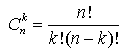
, thus for k=6 and n=49 the total number of possible combinations is:
= 13,983,816. This figure is well known as the total number of possible lotto combinations.
Thus, the probability of hitting all 6 with a single tip is
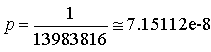
or less than 0.00000715%!
Using this formula, you can easily create a table of the number of lines in full systems:
Number of lines and price
7 lines = €8.40 plus ticket fees
28 lines = €33.60 plus ticket fees
84 lines = €100.80 plus ticket fees
210 lines = €252.00 plus ticket fees
462 lines = €554.40 plus ticket fees
924 lines = €1,108.80 plus ticket fees
1,716 lines = €2,059.20 plus ticket fees
3,003 lines = €3,603.60 plus ticket fees
5,005 lines = €6,006.00 plus ticket fees
8,008 lines = €9,609.60 plus ticket fees
...
all possible 13,983,816 lines (combinations)
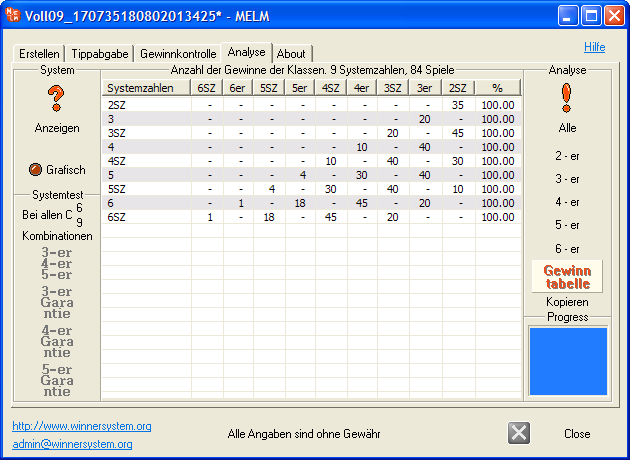
Full systems cover all combinations. Take Full System 009 with 84 lines and analyze it using the MELM function “Create payout table”:
These systems are designed so that with six correct numbers, the corresponding prize tier occurs. The results show that in a 9-number full system, exactly 20 threes occur with 3 correct numbers, and with 6 correct you have a 100% chance of a six (plus several 5s, 4s, etc.). The “only” downside is the high price. If fewer than 3 system numbers are correct—which is likely—the entire stake is lost (also 100%).
VEW systems
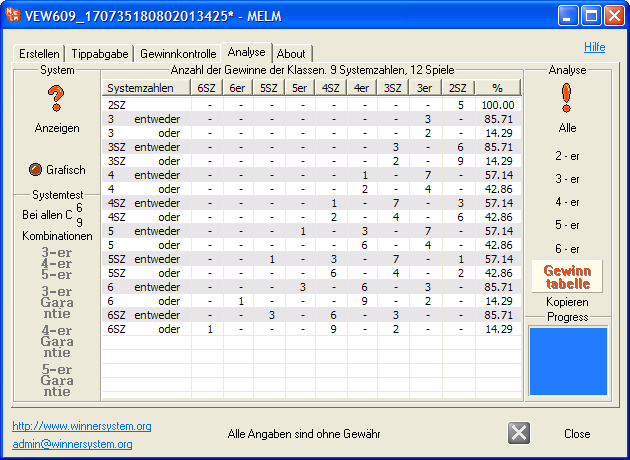
In a VEW system (“Verkürzte Engere Wahl”, reduced close selection), not all combinations are formed. The idea is to reduce stake. All “state” VEW systems guarantee at least the “3outof3” level (if 3 of your system numbers are correct, there is at least one 3). Now let’s analyze VEW 609 (also 9 system numbers, but only 12 lines—€14.40 plus ticket fees; compare that to Full 009 at €100.80 plus ticket fees) using MELM:
With this VEW system, you obviously get threes with 3 correct numbers, but not 20 anymore—typically three 3s in 85% of cases, or two 3s otherwise. And with 6 correct, you have a six with a comparatively modest 15% chance. That’s the trade-off for the lower stake. VEW systems suit long-term play where you want a balance between spend and expected return. With 3 correct here, you often recover more than just your stake.
There is no general algorithm to construct VEW systems, so each VEW system is tied to a specific win (cross-roll) scheme. Knowing a system means knowing its roll-out scheme precisely.
Are state systems optimal? Are there better alternatives?
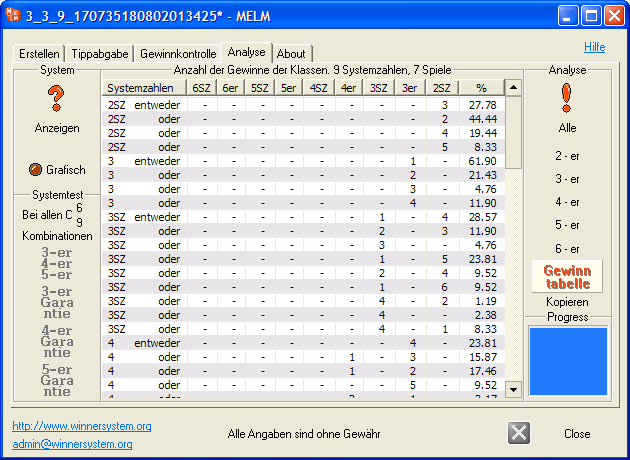
As noted, there’s no algorithm to generate reduced systems or to compute the minimal number of lines needed for a given guarantee level. Given when the official VEW systems were developed (with much slower hardware), modern tools can often do better. Under Software installation you’ll find a link to the best-known guarantee system “all 49 numbers in 163 lines” and how multiple developers improved it over time (from 176 down to 163). There is still no proof that 163 is minimal. For comparison, consider the 3_3_9 system (only 7 lines, €8.40 plus ticket fee; “3_3_9” means the “3outof3” guarantee: with 3 correct system numbers you get at least one 3) in MELM:
Is there a connection between payout tables and other MELM analyses?
Yes—there are relationships between 3/4/5-analyses, analysis of how many 2s/3s/4s/5s/6s a system contains, and the system’s payout table. Detailing this would go beyond the scope here, but a simple rule of thumb: if a system contains all possible 4s for a given set of system numbers, it has at least the “4outof4” guarantee. Compare results across Full 007 and, e.g., 3_3_8, 3_3_9, etc.
What does a win guarantee mean? What are “3outof3”, “3outof4”, “3outof5”?
A win guarantee means the system ensures at least one 3 as a minimum win given the specified number of correct system numbers (at relatively few lines). So “3outof3” means at least one 3 when 3 system numbers are correct; analogously for “3outof4”, “3outof5”. More details under
Lottery systems.
How do I play a VEW system? What is the cross-roll scheme?
To construct and evaluate VEW systems, their win schemes (see VEW 609 example)—also called the “cross-roll” scheme or “knitting pattern”—are used. The official VEW schemes are shown on this site; you can also generate such a scheme with the MELM program (“Export” button) for any loaded or generated system. In practice, the program handles this work—you won’t need to evaluate by hand. If you cannot install the program (e.g., Linux box) or just want to understand it, read on:
To assemble a VEW system from the roll scheme:
1) Choose a VEW system; this fixes the scheme and the number of system numbers. Choose your system numbers.
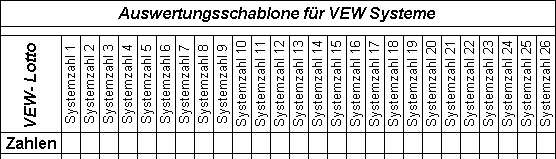
2) Sort your system numbers ascending and copy them into the “Numbers” row of the evaluation template below. (Sorting is discussed in the general description.) The template fits all official VEW cross-roll schemes and is suitable for printing.
3) Now place the template on the roll scheme and slide it downward—you obtain the VEW system in its normal “numbers per line” form (see also Lottery systems).
4) To determine wins, mark the drawn numbers on the template (e.g., with color). While sliding the template, count the crosses in each line: with 4 crosses, you have a 4 in that line. Don’t forget the super number starting from 2 crosses—“2 correct + super number” corresponds to the lowest prize tier 9 (fixed amount €6.00).
Lottery systems